
By Layla Law-Gisiko (candidate in April 28’s NYC Council District 3 Special Election) | It was 1993, and I had only just graduated from La Sorbonne University when I began my first job as a young journalist and producer on Ruban Rouge (Red Ribbon), a one-hour television program entirely dedicated to the HIV/AIDS epidemic. There are gentler ways to enter a profession. My first week was spent speaking with patients who had been diagnosed with HIV. I was significantly younger than some of the people I was interviewing. The epidemic was at its devastating peak, though in so many circles it was still spoken of only obliquely, if at all.
What had already marked me, before I ever stepped into that newsroom, was loss. In the span of a year, I had lost several college mates, as well as my beloved literature professor to the virus. But those losses were surrounded by an unbearable padding of silence, as if they had not died so much as vanished. Their diagnosis was never mentioned in public. No one named what was happening. One day, we were simply told that they no longer were. That was the taboo. That was the chape de plomb, the leaden weight that pressed down on everything and left the rest of us with so many questions, so much confusion, and nowhere to place our grief. The silence was not incidental. It was part of the cruelty.
Each week, our TV program tried to force into view what public discourse preferred to soften, sidestep, or bury. We covered the epidemic from every angle: healthcare, advocacy, public policy, stigma, abandonment, and the catastrophic failures of institutions that had chosen delay over courage. France was reeling from the contaminated blood scandal. Hemophiliac children had been given transfusions carrying the virus. Behind every official euphemism there was a child, a mother, a body, a future overturned. We were not merely covering a health crisis. We were covering a social, political, and moral collapse.
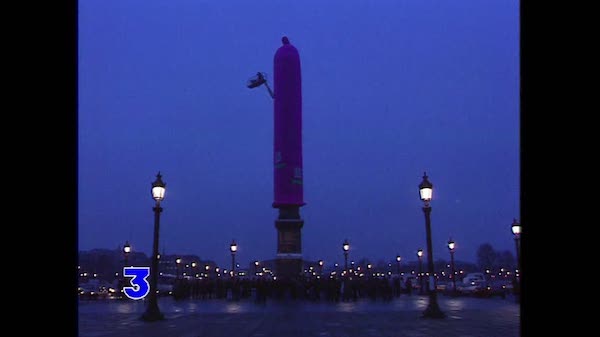
I met many activists in those years, and they educated me as much as any newsroom ever could. Among them was Cleews Vellay, president of Act Up-Paris. He was incandescent with rage, but it was disciplined rage, intelligent rage, rage sharpened into method. He had been instrumental in the famous action at Place de la Concorde, when activists unrolled a giant pink condom over the obelisk. It was theatrical, insolent, impossible to ignore, and therefore exactly right. Cleews understood that when a society grows comfortable with euphemism and denial, disruption becomes a civic duty. His advocacy was sharp, unsentimental, and exacting. He taught me that anger, in the face of abandonment, can be a form of lucidity. Cleews was a gay rights activist who saw the virus as a revealing agent of a bigoted society.
And then there were the patients. I held many hands. I heard many stories entrusted to us by people whose families had sometimes turned away, whose suffering had been made painfully lonelier. I was young and unprepared for the intimacy of that sorrow. There is no real training for the moment when someone speaks to you because no one else will listen. The responsibility of telling the story of such a vulnerable population felt immense. I carried it imperfectly, but with all the seriousness I had. It made me stronger. It made me better. But it also made me profoundly depressed. Powerlessness is not an easy burden for the young.
At the time, I thought our TV program was small against the scale of the health crisis unfolding under our eyes. I thought we were simply documenting devastation while the machinery of indifference rolled on. I did not yet understand that the program itself was power. Giving a voice was power. Naming abandonment was power. Refusing euphemism was power. Telling the truth, week after week, about people whom society preferred not to see, that too was power.
What I learned in those years is something I have never forgotten: silence is epidemic. Silence spreads. Silence isolates. Silence protects institutions and abandons the vulnerable. Silence leaves the living with unanswered questions and the dead with no public name for what took them. And if there was one thing Ruban Rouge refused, it was silence.
That first job marked me for life, and it shaped my understanding of what advocacy requires. It taught me that journalism is not simply the gathering of facts. It is a form of witness. In the midst of the AIDS epidemic, that meant refusing to let gay men be reduced to stigma, silence, or shame. It meant insisting that those whom society had pushed to the margins were not marginal.
I began that work young, frightened, and unequal to much of the sorrow I encountered. But I left it knowing something I have carried ever since: when a society looks away from suffering, to look steadily and to speak clearly is already a form of advocacy. In those years, to tell the truth about AIDS was to stand for gay rights, because silence was never neutral. Silence was complicity. And breaking that silence was part of the fight for justice.
NOTE: The views expressed by our Guest Opinion writers are not necessarily those of Chelsea Community News.
—END—
ChelseaCommunityNews.com (CCNews) is an independent, single-owner online newspaper providing news, arts, events, and opinion content to Manhattan’s Chelsea community and its adjacent areas (Flatiron/NoMad and Meatpacking Districts, Hudson Yards, Hell’s Kitchen, Broadway/Times Square, and the Penn Station area). Our editorial content is made possible by advertising revenue, grants, quarterly pledges of support, and voluntary reader donations (click here for our GoFundMe campaign). To join our subscriber list, click here to receive ENewsletters containing links to recently published content–as well as an occasional “Sponsored Content” email featuring an advertiser’s exclusive message.
ChelseaCommunityNews.com is a member of the New York Press Association (NYPA) and the Empire State Local News Coalition. Our content is collected for placement in the United States Library of Congress’ LGBTQ+ Studies Web Archive. (“We consider your website to be an important part of the historical record,” read a July 26, 2019 email.) Our freelance reporters have been recognized by NYPA’s annual Better Newspaper Contest, with Honorable Mention wins for Best News or Feature Series (2021 & 2023). CCNews is a three-time winner in the Coverage of the Arts category (First Place and Honorable Mention, 2022 and Third Place, 2023).
PLEASE SUPPORT LOCAL JOURNALISM: HELP CHELSEA COMMUNITY NEWS THRIVE BY FREQUENTLY VISITING THIS WEBSITE TO READ OUR ARTICLES AND CLICK ON THE ADVERTISEMENTS.
Questions? Comments? Want to Place an Advertisement or Make a Donation? Email Founder/Editor Scott Stiffler at scott@chelseacommunitynews.com.
You must be logged in to post a comment Login