
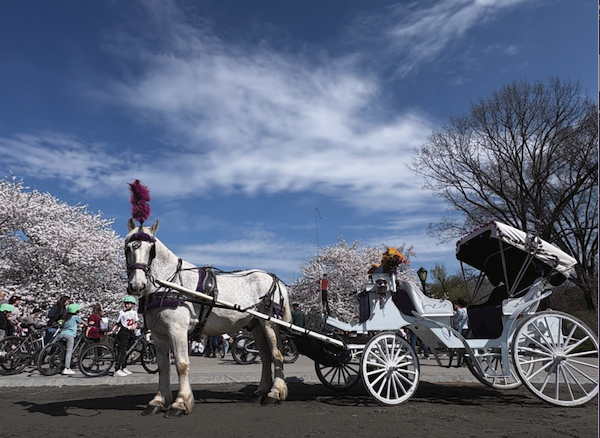
BY ARTHUR SCHWARTZ | You wouldn’t have known it till late October, but there are two sides to the controversy over banning horse-drawn carriages in Central Park—or anywhere else in New York. In October, I found myself meeting with drivers represented by Transport Workers Union Local 100, who were aghast at what was happening to their livelihood. And do you know what? They have quite a case—so much so that I wrote a letter on their behalf to NYC Corporation Counsel Steven Banks threatening to sue the “minute the ink was dry” on an approval of a bill passed by the City Council on October 22.
When I looked at their complaint, I found that the city was establishing a precedent which would let it close down any other lawful business in NYC—not based on some public health emergency—but based on noise being made by a small sector of the public.
One of my clients, Medet Fidan, is a former yellow cab driver. He owned a taxi medallion which he spent over $1 million on and borrowed money to finance it. When Uber and Lyft were legalized (no medallions needed), his medallion became almost worthless. He had to declare bankruptcy. But he kept his head up and bought a carriage medallion to own a Central Park carriage, bought a horse, got a special driver’s license, and began to work in the park. Even though the city’s ban doesn’t take effect until June 2028, the day after the mayor signs the bill, Fidan’s medallion will be worth ZERO. And the bill tells him that he can only sell his horse to certain people, none of which can include entities such as a circus or a riding academy. His carriage will also be worthless. AND do you know what the City Council bill gives him? NOTHING. No money, no new job. NOTHING other than a direction to the mayor to create some sort of “transition plan.”
The Fifth Amendment to the U.S. Constitution bars a “taking” without “just compensation.” So does the New York State Constitution. The most obvious violation is for the medallion owners. We contend that the taking here is “categorical” as defined by the courts, because the proposed bill deprives the owner of all economically beneficial or productive use of their property. This is the same for the carriages. Even the approach to the horses constitutes a taking from their owners. The law’s provisions which direct where the horses must go effectively compels the horses to be transferred to specific locations. This amounts to a physical taking of the animals themselves. Animals are recognized as personal property under state and federal law. There has been no declaration of a public nuisance or a health emergency. The bill jacket cites to a City Bar report, which cites to an article written by one “expert” about how pulling carriages is “bad” for the horse.
My legal research led me to the last time the city attempted to ban a licensed business. In 1940, the city and the mayor barred “street peddling.” No more food carts would be allowed on the street. The Good Humor Company sued. They went all the way to the Court of Appeals (New York’s top court) which said this:
(W)e may assume that the Legislature might even authorize a city by local law to refuse to license any peddlers and to stop all peddling if complete prohibition rather than regulation of peddling is a reasonable measure to stop abuses. It would nonetheless be a drastic method of ending abuses—a method that may be used only where the abuses are general and difficult to control by regulation and where they cause or threaten injury to the public so serious that the Legislature might reasonably find it outweighs the harm that would be caused to some by complete prohibition… It thus clearly appears that the business of selling merchandise in the streets of the city can be conducted without creating any of the evils which we are told the local law is intended to prevent. Such evils arise only when those who carry on such a business resort to evil practices. All such evils can be avoided by voluntary regulation of the business or by compulsory regulation in accordance with a reasonable statute or ordinance enforced by the police with the cooperation of judicial officers. A business conducted in the manner in which the plaintiff conducts its business promotes the public convenience without causing any injury to the public. An ordinance which prohibits a business so conducted because others conduct a similar business in a manner which creates conditions which the public should not be compelled to tolerate, is patently unreasonable.
Can the city better regulate the horse carriage profession? It has engaged in regulation in the past, for example, by requiring that all rides be in the park (which is car-free) and that carriages waiting for passengers park inside the park rather than on 59th Street. I think the city should build a stable in the park and create a grazing area for the horses off-hours. What a great attraction that would be. They could shorten the limits on the horses’ work time and bar work in certain weather. (There are regulations in place now, they could be tightened.)
Yes, over the last year a young man was killed when a horse reared after being scared by an electrical spark from a Con Ed facility. But since then, two people have been killed by an e-bike in Central Park. I haven’t heard of any legislation to ban e-bikes—something a lot of people would welcome! But this death, and the death of one horse this year from eating a weed in the park which it was allergic to, doesn’t justify ending the livelihoods of 150 carriage drivers, 70 medallion owners, many of whom co-own the building where their stables are—a building near Hudson Yards that some developer would love to get.
The city is overreaching here—and violating the constitutional rights of 150 people. It’s a fight worth fighting.
Arthur Schwartz is general counsel of the Transport Workers Union, which represents the carriage drivers in Central Park. The above content first appeared in the November 2026 issue of Village View. It is reprinted with author/publisher’s permission.
NOTE: The views expressed by our Guest Opinion writers are not necessarily those of Chelsea Community News.
—END—
No paywall. No pop-up ads. Why? Because we like you.
Launched on April 23, 2019, ChelseaCommunityNews.com (CCNews) is an independent online newspaper serving Manhattan’s Chelsea community and adjacent areas (Flatiron/NoMad & Meatpacking Districts, Hudson Yards, Hell’s Kitchen). Our free editorial content is made possible by advertising revenue, grants, quarterly pledges of support, and voluntary reader donations (click here to donate). To subscribe to our free ENewsletter, click here. ChelseaCommunityNews.com is a member of the New York Press Association (NYPA) and the Empire State Local News Coalition. Our work is collected for placement in the United States Library of Congress’ LGBTQ+ Studies Web Archive. Honors at NYPA’s annual Better Newspaper Contest, 2021-2025, include 3 wins for Coverage of the Arts, and 2 wins for Best News or Feature Series.
HELP SUPPORT US BY VISITING THIS WEBSITE TO READ OUR ARTICLES AND CLICK ON THE ADVERTISEMENTS.
Questions? Comments? Email Founder/Editor Scott Stiffler at scott@chelseacommunitynews.com.
You must be logged in to post a comment Login